Homes for sale in St. Leonard Maryland put you in the part of Calvert County that most buyers outside the area have never heard of, and that is exactly why it is worth knowing. This is southern Calvert at its most rural and most authentic: large wooded lots, access to the Patuxent River and the Chesapeake Bay, almost no traffic lights for miles, and two natural landmarks that exist nowhere else in the Mid-Atlantic. I grew up in Calvert County. I know St. Leonard the way most agents know their own neighborhood, because for a stretch of my life it was. If you are searching for homes for sale in St. Leonard Maryland and want a straight read on the market, what you will actually find at different price points, what the schools and commute reality look like, and what to watch for before you make an offer, this guide covers all of it.
James Armel | JPAR Real Estate | (301) 751-9318 | jamesarmelrealestate.com
Table of Contents
What Sets St. Leonard Apart from the Rest of Calvert County
Calvert County runs about 35 miles from tip to tip, and the character changes as you go south. Chesapeake Beach and North Beach at the north end feel like waterfront resort towns with a year-round residential core. Dunkirk and Huntingtown in the middle are family suburbs with strong school ratings and a steady flow of D.C. commuters. Prince Frederick at the center is the county seat, the commercial core, and the place where Route 4 briefly feels like a real highway with grocery stores, a hospital, big-box retail, and every service you need within a few miles.
St. Leonard sits in the lower third, south of Prince Frederick on the corridor toward Solomons Island. It does not have a town center. It does not have a main street. What it has is large wooded lots that often back up to mature hardwoods or creeks, a rural pace that feels genuinely quiet rather than just far from traffic, and access to natural landmarks that most Marylanders have never seen in person. The Chesapeake Bay runs along the county’s eastern edge here, and Flag Ponds Nature Park sits directly on the Bay within the St. Leonard zip code. Battle Creek Cypress Swamp, one of the northernmost natural stands of bald cypress trees on the East Coast, is a few minutes from residential streets. The Cove Point Lighthouse stands at the southern edge of the community, built in 1828, one of the oldest lighthouses still in operation on the Chesapeake.
Buyers who find St. Leonard are usually looking for one of a few things: more land for less money than Dunkirk or Huntingtown, proximity to Solomons Island without Solomons prices, rural character without sacrificing quick access to Prince Frederick, or a waterfront property on the Patuxent River or the Bay. All of those are legitimate. All are achievable here. Buyers comparing options along the Route 4 corridor can also explore our guide to homes for sale in Lusby Maryland.

Homes for Sale in St. Leonard Maryland: Prices and What You Get
Most homes for sale in St. Leonard Maryland are single-family detached homes on large lots, often half an acre to several acres. The community is almost entirely residential, with no condominium developments and very few townhome clusters. What that means in practice is that you are buying privacy and land at almost every price point.
At the lower end of the market, roughly $300,000 to $375,000, you will find older ranchers and colonials from the 1970s through the 1990s on half-acre to one-acre lots. These homes are typically on well and septic rather than public water and sewer, which is standard throughout rural Calvert County and something I cover in the due diligence section below. They are often solid construction, have been lived in by long-term owners, and may need cosmetic updating. For buyers with a realistic eye and patience for a thorough home inspection, this is where St. Leonard offers genuine value that you will not find at the same price in Dunkirk or Chesapeake Beach.
From $375,000 to $500,000, the inventory opens up considerably. You will find updated colonials, newer construction from the 2000s and 2010s, and homes with more finished square footage on larger lots. Some of these properties have detached garages, outbuildings, or substantial cleared yard space that does not exist in the more subdivided northern half of the county. If you compare St. Leonard to Dunkirk or Huntingtown at the same price point, the tradeoff is consistent: you get more land and more privacy here, and slightly longer drives to the commercial amenities on the Route 4 corridor.
Above $500,000, you enter what I think of as the true St. Leonard sweet spot: larger homes on two or more acres, often in wooded settings with long driveways and real seclusion. Some of these properties have outbuildings or detached workshops that attract buyers who run small businesses or need serious storage. A few have creek access or seasonal water views. The Calvert County median sale price as of July 2026 sat at $492,500 according to Bright MLS data. Non-waterfront St. Leonard tends to track at or slightly below county median, which makes the land-per-dollar math genuinely favorable compared to the more densely subdivided parts of the county.
Waterfront properties are a separate category entirely. Patuxent River frontage in this area starts around $600,000 for smaller cottages and runs well into seven figures for deep-water lots with significant dock infrastructure. I cover those specifically in the waterfront section below.
Communities and Areas Within St. Leonard
St. Leonard is technically an unincorporated community rather than an incorporated municipality, which means there is no city hall, no city services, and no defined incorporation boundary. What most people call St. Leonard covers a broader area that includes several smaller named communities, each with its own distinct character and access patterns.
Port Republic
Port Republic sits at the northern edge of the St. Leonard area, at the confluence of St. Leonard Creek and the Patuxent River. This is one of the oldest continuously settled communities in Calvert County, with a history that traces back to the colonial period. The housing stock here is a mix of historic homes, mid-century ranchers, and occasional newer construction on large lots. Port Republic School serves this community as a combined K-8 school, which is unusual in Calvert County. Rather than splitting into separate elementary and middle buildings, Port Republic School covers kindergarten through eighth grade on a single campus. Buyers with school-age children who prefer a smaller, more consistent school community often find this arrangement genuinely appealing compared to the typical elementary-to-middle transition.
The Port Republic area also has some of the most desirable creek frontage in the St. Leonard zip code, with homes along St. Leonard Creek offering protected water access to the Patuxent. Creek frontage is generally less expensive than open Patuxent frontage and carries lower wind and wave exposure, which affects dock permitting, insurance requirements, and long-term maintenance costs. For buyers who want waterfront without the open-Bay exposure, creek properties in this area are worth a specific look.
Dowell
Dowell is a small waterfront community at the mouth of St. Leonard Creek where it meets the Patuxent River, giving it a distinct peninsula character with water on multiple sides. Homes in Dowell tend to be on smaller lots than inland St. Leonard properties, many with direct water views or water access. The community has a marina and a handful of waterfront restaurants, and it feels more like Solomons Island in character than like the rural inland properties. If you want Patuxent River water views and the ability to walk to a dock or a waterfront restaurant without paying Solomons prices, Dowell is worth a specific comparison.
The Cove Point Area
Cove Point sits at the easternmost tip of the county within the St. Leonard zip code, directly on the Chesapeake Bay. The Cove Point Lighthouse, built in 1828, stands here and is one of the oldest surviving lighthouses on the Chesapeake Bay in continuous operation. The Dominion Energy Cove Point LNG facility is also located in this area and is one of the larger employers in Calvert County, supporting well-paying trades and engineering employment in the region. Residential properties near Cove Point are predominantly single-family homes on larger lots, some with Bay views or Bay access. The eastern shoreline here is quieter than the Chesapeake Beach section of the county to the north, with less tourism infrastructure and more of a private, year-round residential feel.
The Flag Ponds Road Corridor
Running from Route 2/4 down toward the Chesapeake Bay, Flag Ponds Road passes through one of the more wooded and rural sections of St. Leonard before reaching Flag Ponds Nature Park at the Bay. Properties along this corridor are almost entirely large-lot single-family homes in wooded settings. There is no commercial activity, no through traffic, and a genuine sense of being far from suburban development even though Prince Frederick is 15 minutes north on Route 4. For buyers who want rural character with quick access to the county’s main commercial corridor, this stretch delivers it.
Natural Landmarks That Define Life in St. Leonard
Most Calvert County depth pages mention Calvert Cliffs State Park in the same breath as the county itself. Calvert Cliffs is further north in the county. The natural landmarks specific to St. Leonard are different from Calvert Cliffs and in some ways more unusual. If you are buying here, these three are worth knowing before you move in.
Flag Ponds Nature Park
Flag Ponds Nature Park sits on the western shore of the Chesapeake Bay within the St. Leonard zip code, encompassing 327 acres of forest, wetlands, and shoreline. The park offers something uncommon on this stretch of the Bay: a sandy beach accessible by a trail through the forest, at the base of the same type of fossil-bearing cliffs that made Calvert Cliffs famous to the north. Shark teeth and marine fossils are regularly found at Flag Ponds, and the park allows fossil hunting on the beach. This is a park where children can walk out with something they found, not just something they bought.
Flag Ponds is less crowded than Calvert Cliffs State Park, the trail to the beach is manageable for most ages, and the Bay views from the beach are unobstructed. County residents pay a lower park admission rate than non-residents. Many St. Leonard homeowners walk or bike here on weekends. For buyers with children, this is the kind of local amenity that does not appear in a standard real estate listing but significantly affects quality of life.
Battle Creek Cypress Swamp
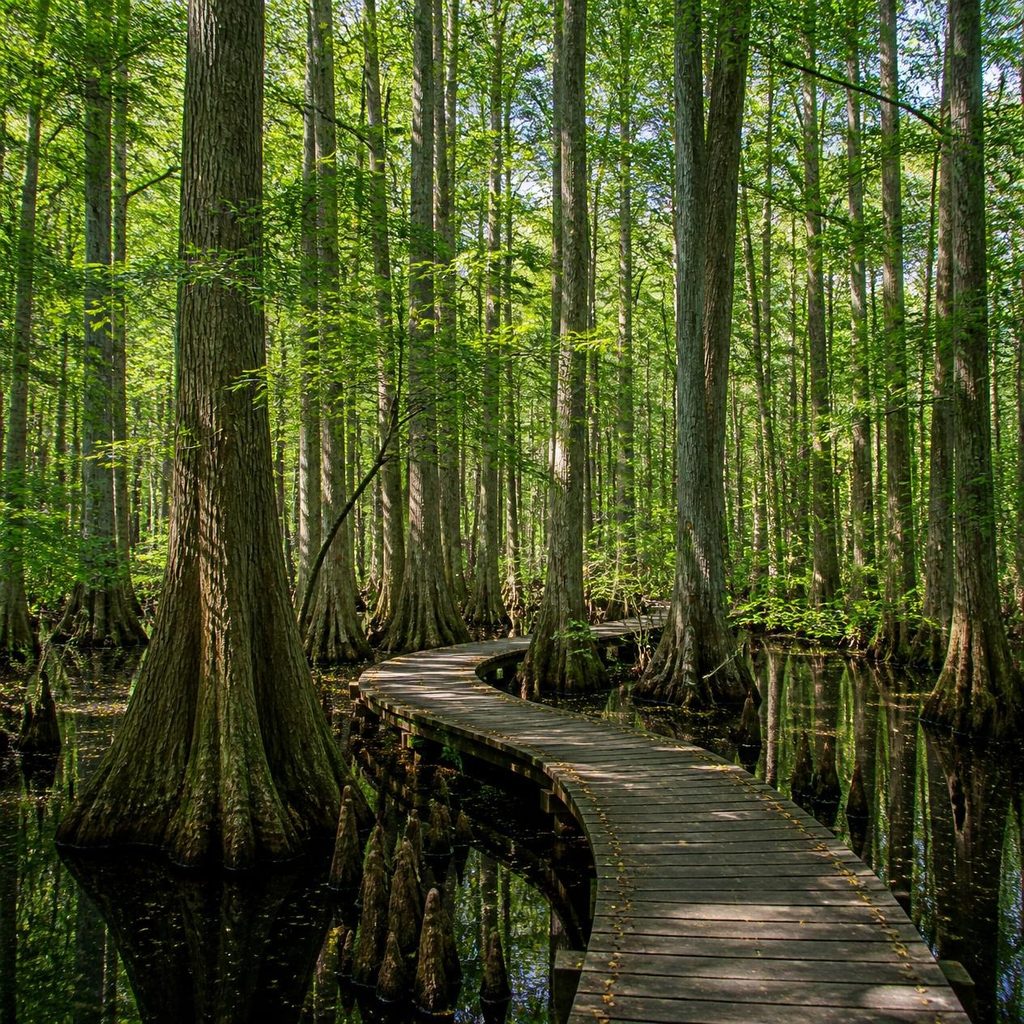
Battle Creek Cypress Swamp Sanctuary is a 100-acre nature preserve managed by The Nature Conservancy in cooperation with Calvert County, and it is one of the most ecologically unusual places in Maryland. It contains the northernmost natural stand of bald cypress trees on the East Coast. Bald cypress are a tree species associated with the Deep South, the Okefenokee Swamp, and the Florida Everglades. The fact that a naturally occurring stand exists in Calvert County, Maryland, at this latitude is genuinely uncommon from a botanical standpoint, and it draws naturalists and school groups from across the region.
The sanctuary has a boardwalk trail that takes visitors through the cypress grove at water level, close enough to see the distinctive cypress knees rising from the swamp floor and the canopy closing overhead. The trail is free and open to the public. For buyers moving here from outside Southern Maryland, Battle Creek Cypress Swamp is often the single most surprising thing they discover after closing. It exists in a handful of places on the East Coast. One of them is a few minutes from residential streets in St. Leonard.
Cove Point Lighthouse
The Cove Point Lighthouse was built in 1828 and stands 45 feet tall on the Chesapeake Bay shoreline. It is one of the oldest surviving lighthouses on the Chesapeake still in active service, and the keeper’s cottage and grounds are preserved as a historic landmark. For buyers who care about the character and history of where they live rather than just the square footage and commute, the lighthouse is a genuine piece of Chesapeake heritage that most people outside southern Calvert County have never seen.
The Battle of St. Leonard Creek: Why History Here Is Not Abstract
In June 1814, the largest naval engagement in Maryland during the War of 1812 took place in the creek that runs through this community. Commodore Joshua Barney commanded the Chesapeake Bay Flotilla, a fleet of American gunboats, and spent several weeks fighting a British naval force that had pursued the flotilla up the Patuxent River. The engagements at St. Leonard Creek on June 10 and June 26, 1814, involved hundreds of sailors and significant cannon fire along both banks of the creek. The battles bought critical time for American forces in the region during the British Chesapeake campaign that would later include the burning of Washington.
The creek where this happened is the same St. Leonard Creek that runs through the Port Republic community today. Kayakers paddle it on weekends. Homeowners with waterfront lots have docks on it. The history of this area is not confined to a museum exhibit or a roadside marker. It is in the water itself, and in the names of the roads and communities that have been continuously inhabited here for more than 200 years.
I mention this not because it changes home values but because it is part of what buyers from outside Southern Maryland consistently miss when they evaluate this area purely on square footage and commute time. St. Leonard has been a named, inhabited, fought-over community for longer than most American cities have existed. That kind of depth is part of what makes Southern Maryland feel like home rather than just a real estate transaction.
Schools Serving St. Leonard Maryland
Calvert County public schools are consistently among the stronger school systems in the greater Southern Maryland region. The specific school assignments within the St. Leonard zip code depend on the exact property address, so always verify current boundaries directly with Calvert County Public Schools before making a final decision based on school assignments. Boundaries can shift, and the information below reflects the general structure rather than a guarantee of specific assignment for a specific address.
The Port Republic community within St. Leonard is served by Port Republic School, a combined K-8 school that operates differently from most Calvert County schools. Rather than splitting into a separate elementary and middle building, Port Republic School covers kindergarten through eighth grade on a single campus. This structure creates a smaller and more consistent school community for students across their elementary and middle school years, with the same faculty, administration, and peer group carrying through. For families who value smaller school environments and continuity of relationships over the larger middle school experience, Port Republic School is a meaningful feature of buying in that specific community.
Other parts of the St. Leonard zip code are served by Mutual Elementary School, which feeds into Calvert Middle School and Calvert High School, both located in Prince Frederick. Calvert High School is the county’s largest high school and offers a full range of AP courses, dual enrollment options, career and technical pathways, and competitive athletic and extracurricular programs. It serves students from across the southern portion of Calvert County and is the destination school for the majority of St. Leonard families.
Private school options in the area include The Calverton School in Huntingtown, a private K-12 institution that has operated in Calvert County for several decades and draws students from across the county and from neighboring Charles and St. Mary’s counties. A number of St. Leonard families choose Calverton for the smaller class sizes, the continuous K-12 curriculum under a single administration, and the academic culture it has built over time. Families considering Calverton should contact the school directly for current enrollment and availability.
Commute Times from St. Leonard Maryland
Commute reality is worth being straight about for St. Leonard because the location is in the southern portion of the county, not the northern end closest to Prince George’s County and the Beltway. Here is what commute times actually look like from a central St. Leonard address under normal conditions:
Prince Frederick: 15 to 20 minutes north on Route 2/4. Prince Frederick is where the main commercial corridor is, including grocery stores, Calvert Memorial Hospital, restaurants, Home Depot, and most of the services you need on a regular basis. Daily errands in Prince Frederick are easy from St. Leonard, and the drive is quick enough that it does not feel like an event.
Solomons Island: 15 to 20 minutes south. Solomons has waterfront dining, marinas, the Calvert Marine Museum, and the boardwalk on the Patuxent River narrows. St. Leonard sits almost exactly between Prince Frederick and Solomons, which gives residents easy access to both without being inside either community. This is not an accident of geography. It is one of the reasons St. Leonard has attracted buyers who want the lifestyle of Solomons without paying Solomons prices.
NAS Patuxent River: 25 to 35 minutes south, depending on traffic and the specific gate entrance. Route 4 through St. Leonard is a direct path south toward Route 235 and the base. For military families considering the Pax River market, St. Leonard is a legitimate commute community, particularly for those who prefer to be outside the Lexington Park concentration area and want a more rural environment for their family. The drive is straightforward with no complicated interchanges.
Naval Support Facility Indian Head: Approximately 45 to 55 minutes west via Route 4 north and then Route 225 or Route 6 west through Charles County. Not a short commute, but manageable for those on compressed work schedules or with flexibility in their start times.
Washington D.C.: 75 to 100 minutes under normal conditions, typically via Route 4 north through Prince Frederick and Prince George’s County, connecting to the Beltway. Rush-hour traffic on Route 4 through Upper Marlboro and Forestville adds significant time. Commuters from St. Leonard to D.C. need to be comfortable with this drive, plan their schedule around traffic windows, or have substantial remote work flexibility. This is the honest version of that commute. It is a real drive and not a short one.
Annapolis: Roughly 55 to 70 minutes via Route 4 north to Route 2 north or Route 50 east. Not a daily commute route for most people, but manageable for periodic trips and weekend visits.
The commute trade-off in St. Leonard is the same one buyers have been making in southern Calvert County for generations: you give up proximity to the Beltway corridor and get rural land, water access, and a pace of life that is not available 30 minutes closer to D.C. Whether that trade makes sense depends entirely on what you are optimizing for. For buyers with remote or hybrid work arrangements, St. Leonard has become significantly more attractive since 2020 for exactly this reason.

Waterfront Homes for Sale in St. Leonard Maryland
The waterfront inventory among homes for sale in St. Leonard Maryland falls into two primary categories: Patuxent River and creek frontage, including St. Leonard Creek and its tributaries, and Chesapeake Bay frontage in the Cove Point and Flag Ponds corridor. These are meaningfully different water bodies with different property characteristics, different insurance requirements, and different buyer profiles.
Patuxent River and St. Leonard Creek frontage gives you protected water with boat access to the Patuxent and from there to the Chesapeake Bay. Creek frontage in particular offers calmer conditions, easier dock maintenance, and typically lower flood insurance costs than open Bay frontage. The critical due diligence item on creek and river properties is water depth. Depths vary significantly along both banks depending on the specific lot and the tidal channel’s path, and buyers who need sufficient draft for a larger powerboat or sailboat need to verify the sounding at their specific location, not at the nearest marina. This is not a negotiating point. It is a structural fact about tidal waterways in Southern Maryland, and it needs to be confirmed before you make an offer.
Chesapeake Bay frontage near Cove Point and the Flag Ponds corridor gives you open water, unobstructed Bay views, and access to one of the most productive recreational fishing areas on the East Coast. Rockfish, bluefish, striped bass, and Spanish mackerel are common in this stretch during fall. Open Bay frontage also means more wave action, higher flood insurance requirements under FEMA flood zone designations, and more rigorous Critical Area Commission review for any improvements within 1,000 feet of the tidal water’s edge, including dock construction, bulkhead replacement, and vegetation removal.
Current waterfront homes for sale in St. Leonard Maryland typically range from approximately $600,000 for smaller or dated waterfront cottages with modest dock infrastructure to well over $1,200,000 for larger homes with deep-water access, significant dock systems, and direct Chesapeake Bay views. Properties in the upper range are relatively rare on the active market at any given time. When they appear, they attract buyers from outside the immediate area who have been watching the market for a specific configuration.
If you are buying waterfront in St. Leonard, the due diligence process is more involved than a non-waterfront purchase and the stakes of missing something are higher. I have worked waterfront transactions throughout southern Calvert County for 14 years, including properties with complex pier permitting histories, FEMA map amendments, and Critical Area violations that required resolution before closing. I know what to look for and I look for it on every waterfront transaction I work.
What Buyers Need to Know Before Making an Offer
St. Leonard is rural Calvert County, which creates a specific set of due diligence items that do not apply to buyers purchasing in subdivisions with public utilities. Most buyers who have only purchased homes in suburban Maryland have not encountered some of these before. Here is what matters:
Well and Septic
The overwhelming majority of homes in St. Leonard are on private well water and individual septic systems rather than public water and sewer. This is standard for rural Calvert County and not a defect. It does mean that well water testing and a septic inspection are non-optional parts of the due diligence process. Maryland law requires a septic inspection on home sales, but the standard inspection does not always catch a drainfield that is failing slowly rather than visibly. Ask specifically about the age of the system, the location of the drainfield, and the available capacity. These questions matter, and I ask them on every rural transaction I work. Replacing a failing septic system in Calvert County runs $15,000 to $35,000 depending on the type and lot conditions. That is a number you want to know before closing, not after.
Well water quality varies across the county depending on geology and proximity to agricultural land. Have the water tested for coliform bacteria, nitrates, and any contaminants relevant to the specific area. These tests cost a few hundred dollars. They are inexpensive relative to the cost of discovering a problem after you have moved in.

Flood Zones and FEMA Designations
Non-waterfront properties in St. Leonard are generally not in FEMA-designated Special Flood Hazard Areas, but some lots near creeks, drainageways, or low-lying areas closer to the Bay are. Run the address through FEMA’s Flood Map Service Center before making an offer. Flood insurance is a separate policy from homeowner’s insurance, required by lenders on properties in Special Flood Hazard Areas, and can add several thousand dollars per year to carrying costs depending on the zone and the structure. Know the zone before you are surprised at the insurance quote.
Waterfront properties near the Chesapeake Bay or tidal portions of the Patuxent River are almost always in a FEMA Special Flood Hazard Area. This is expected and is priced into waterfront values throughout the region, but the flood insurance math needs to be part of your offer calculations from the beginning.
Critical Area Commission Rules
Maryland’s Critical Area Commission governs land use within 1,000 feet of tidal waters and tidal wetlands. For waterfront properties and properties near tidal creeks, this means that certain improvements, including dock construction or expansion, bulkhead or shoreline work, and significant ground disturbance, require Critical Area Commission approval in addition to standard county permits. This is not a reason to avoid waterfront property, but it is a reason to understand what you are and are not permitted to do before you close. Buyers who purchase waterfront expecting to build a larger dock or clear vegetation to the water’s edge sometimes discover that those plans require a more involved approval process than anticipated.
HOA and Property Owners Associations
Many St. Leonard properties have no homeowner’s association, which is one of the things rural Calvert County buyers find genuinely appealing. No HOA means no monthly fees, no architectural review, and no restrictions beyond county zoning ordinances. It also means no collective enforcement of standards that affect your neighbors’ property, and no shared legal representation if a community-wide issue arises. Some buyers strongly prefer no HOA. Know which side you are on before you start targeting specific properties, because the HOA status is generally fixed.
Some community subdivisions within the broader St. Leonard area do have property owners associations, particularly waterfront communities where shared pier access, community boat ramps, or community amenities require collective maintenance funding. Verify the HOA or POA status on any property you are considering before you make an offer, review the governing documents before you waive any contingencies, and calculate the annual fees into your total cost of ownership.
How James Armel Works with Buyers Looking for Homes for Sale in St. Leonard Maryland
When buyers ask me about homes for sale in St. Leonard Maryland, I start by asking what they are actually optimizing for, because St. Leonard delivers very specifically on certain things and not on others. If someone needs a short commute to D.C. every day or wants walkable retail within five minutes, St. Leonard is not the right answer and I will say so before we spend time on it. If they want land, genuine quiet, access to natural spaces that most Marylanders have never seen, and a price point that gives them more per dollar than anywhere else in Calvert County at a comparable quality level, St. Leonard is one of the better-positioned markets in Southern Maryland.
I grew up in Calvert County. This stretch of the county between Prince Frederick and Solomons was the landscape I drove through for years before I had a license to show houses in it. That is a different kind of knowledge than having closed a few transactions in a market. It means I know which roads flood in heavy rain, which communities have the best natural light exposure in winter, and which lot configurations will make future expansion difficult even when a listing does not mention it. I am also a real estate investor with 7 years of that work behind me, which means I evaluate properties the way an owner evaluates them, not the way a transactional agent does. Those two perspectives together are why my clients rarely have surprises after closing.
My licensed executive assistant Aimee works with every buyer I represent after they go under contract. She tracks every deadline and contingency, coordinates with title companies and lenders, and is my immediate backup when I am on the road or at another showing. For buyers navigating the specific complexities of rural Calvert County, including well and septic inspections, flood zone research, Critical Area restrictions, and the occasional estate sale or older home with deferred maintenance, that second set of eyes is not a luxury. It is how we catch problems before they become your problem after closing.
I do not work buyers in St. Leonard as an afterthought to a larger suburban practice. Southern Maryland is the only market I have worked in for 14 years, and the southern half of Calvert County is a market I know from the ground up. Call or text me at (301) 751-9318 if you want to see what is available and get a straight read on value without a sales pitch attached.
Meet Aimee: Two Licensed Sets of Eyes on Every Transaction
Aimee is James’s licensed executive assistant, born and raised in Maryland and licensed for over a decade. She does not buy or sell on her own, but she works with every client after they go under contract: tracking every deadline and contingency, coordinating with title companies and lenders, and making sure nothing falls through the cracks. When you work with James, you get both of them. That matters on every transaction, and it matters especially in rural Calvert County where well, septic, Critical Area, and flood zone issues require careful attention through closing.
Frequently Asked Questions: Homes for Sale in St. Leonard Maryland
What is the price range for homes for sale in St. Leonard Maryland?
Homes for sale in St. Leonard Maryland currently range from approximately $300,000 for older ranchers and colonials on half-acre lots to $500,000 and above for newer construction or larger properties on two or more acres. Non-waterfront St. Leonard tends to track at or slightly below the Calvert County median, which sat at $492,500 as of July 2026 per Bright MLS data. Waterfront properties on the Patuxent River or Chesapeake Bay start around $600,000 for smaller cottages and can exceed $1,200,000 for larger homes with deep-water dock access and open Bay views. Prices shift based on lot size, water frontage, condition, and current inventory. Contact James at (301) 751-9318 for a current market read on a specific price range or community.
Are there waterfront homes for sale in St. Leonard Maryland?
Yes. Waterfront homes for sale in St. Leonard Maryland are available on both the Patuxent River and the Chesapeake Bay side of the community. St. Leonard Creek, which enters the Patuxent at Port Republic, also has waterfront and water-access properties with protected creek frontage. Waterfront inventory in this area tends to move when it appears because the price-per-waterfront-foot is meaningfully lower than Solomons Island or Chesapeake Beach at comparable water quality. Due diligence on waterfront properties here should always include a water depth verification, a FEMA flood zone check, and a review of any Critical Area restrictions on the specific lot.
What are the schools like for families buying in St. Leonard?
St. Leonard falls within Calvert County Public Schools, which is one of the stronger school systems in the Southern Maryland region. The Port Republic community within St. Leonard is served by Port Republic School, a combined K-8 school. Other parts of the zip code feed into Mutual Elementary, Calvert Middle School, and Calvert High School in Prince Frederick. The Calverton School in Huntingtown is a private K-12 option used by a number of Calvert County families. Always verify the specific school assignment for an address directly with Calvert County Public Schools before finalizing a purchase based on school boundaries.
How far is St. Leonard Maryland from Washington D.C.?
St. Leonard is approximately 75 to 100 minutes from Washington D.C. under normal traffic conditions, via Route 4 north through Prince George’s County to the Beltway. Rush-hour traffic on Route 4 through Forestville and Upper Marlboro adds meaningful time to this commute. St. Leonard is better suited to buyers who commute to D.C. two or three days per week, who work with schedule flexibility around peak traffic windows, or who have hybrid or remote work arrangements. For buyers who need to be in a D.C. office every day, the northern end of Calvert County near Chesapeake Beach or Dunkirk offers a shorter commute at the cost of higher prices and less land.
What is Battle Creek Cypress Swamp and how close is it to homes in St. Leonard?
Battle Creek Cypress Swamp Sanctuary is a 100-acre nature preserve containing the northernmost natural stand of bald cypress trees on the East Coast. It is located within the St. Leonard area of Calvert County and is a few minutes by car from most residential addresses in the zip code. The sanctuary has a free boardwalk trail through the cypress grove and is managed by The Nature Conservancy with Calvert County. For families, naturalists, and buyers who value proximity to unusual natural spaces, it is one of the most distinctive amenities in the St. Leonard area and one that has no equivalent elsewhere in Maryland.
Ready to Look at Homes for Sale in St. Leonard Maryland?
If you are seriously looking at homes for sale in St. Leonard Maryland and want a local agent who knows the market from the ground up, call or text James Armel at (301) 751-9318. James has worked buyers in Calvert County for 14 years, knows the well and septic considerations specific to rural southern Calvert, and will give you a straight read on value without a sales pitch attached. Fill out the form below and James will be in touch to discuss what you are looking for and what is currently available.
Disclaimer: Home price ranges cited in this guide are based on Bright MLS data for Calvert County and southern Calvert County as of mid-2026 and are provided for general informational purposes only. Individual property values vary based on condition, lot size, water access, and current market conditions. Well and septic, flood zone, and Critical Area information reflects general conditions in the area and is not a substitute for professional inspections or legal review of a specific property. This page is for informational purposes only and does not constitute legal, financial, or real estate advice for a specific transaction.
Sources
- Bright MLS: Calvert County sales data, July 2026
- Calvert County Government: Parks, schools, and land use information
- FEMA Flood Map Service Center: Flood zone designations
- Maryland Critical Area Commission: Critical Area regulations